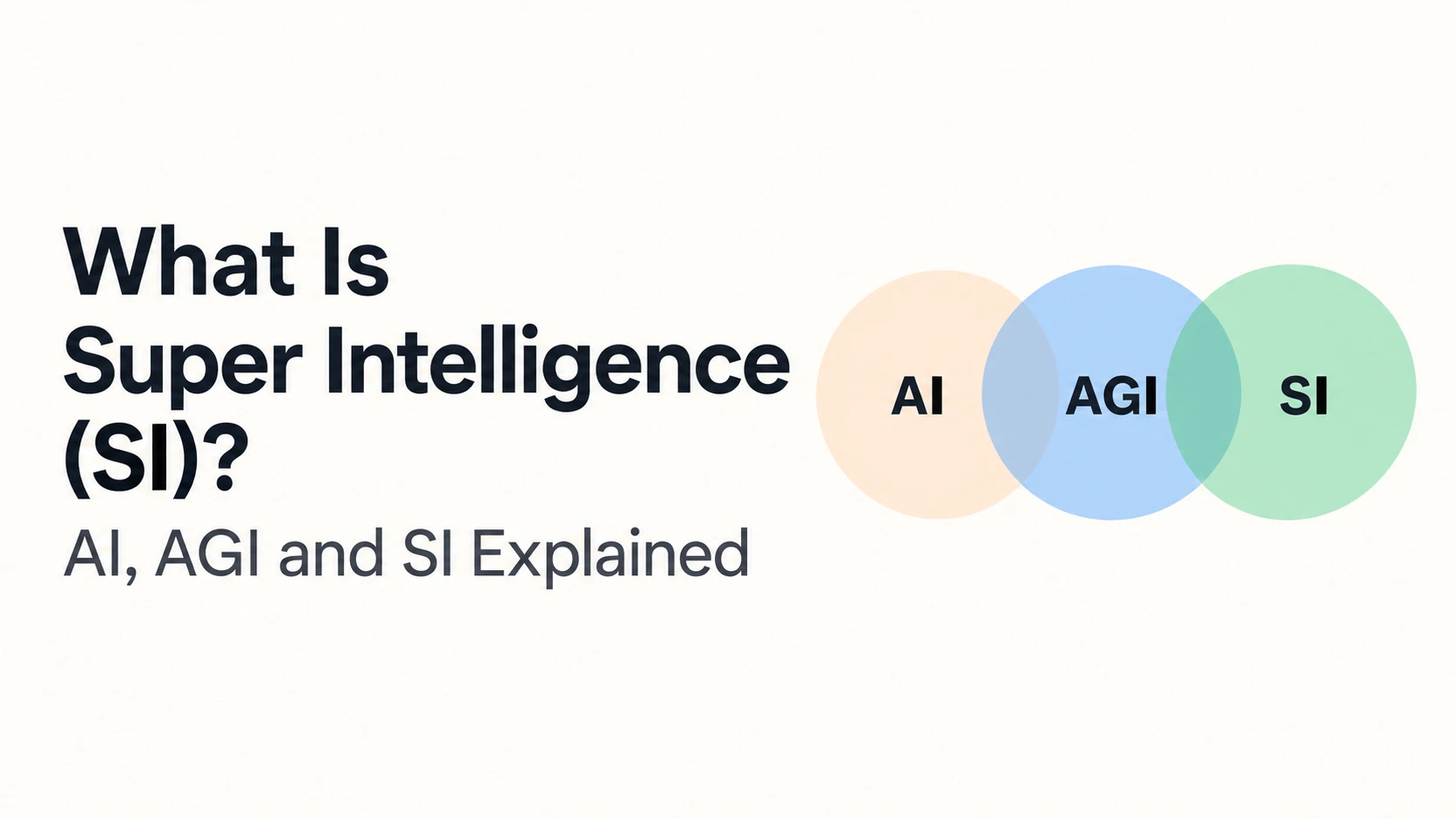
What Is Super Intelligence (SI)? AI, AGI and SI Explained
AI terminology has always moved faster than the systems behind it.
A few years ago, most business conversations were simply about artificial intelligence and machine learning.
Then generative AI became its own category.
Large language models became mainstream. AI agents followed. AGI moved from research discussions into everyday technology conversations.
Now another term is starting to appear much more frequently: Super Intelligence, or SI.
The term itself isn't new.
What has changed is the context around it.
Superintelligence traditionally describes a hypothetical level of machine intelligence beyond broad human capability. But SI is now also being used in a much wider way, including by the U.S. executive branch as replacement terminology for Artificial Intelligence (AI).
Those definitions are not the same.
And if SI becomes more common in products, policy, search, and technical documentation, that distinction is going to matter.
Here's how AI, AGI, and SI actually differ, what Super Intelligence would require technically, where current AI systems fit, and what businesses should understand before treating SI as simply the next version of AI.
What Is Super Intelligence (SI)?
Super Intelligence usually refers to a hypothetical form of machine intelligence that exceeds human intellectual capability across a broad range of tasks. It goes beyond today's task-focused AI and beyond the usual concept of human-level Artificial General Intelligence (AGI). However, SI now also has a newer U.S. government meaning as replacement terminology for AI.
That gives us two meanings to keep separate.
- Technical superintelligence: a hypothetical system with general intellectual capabilities beyond those of humans.
- SI as U.S. government terminology: the term the executive branch has been directed to use instead of Artificial Intelligence or AI where permitted by law.
If someone says "SI" today, context matters.
An AI researcher discussing the path from AGI to superintelligence may be talking about a future capability threshold.
A U.S. federal document using SI may simply be referring to technology that would previously have been called AI.
That distinction prevents a lot of unnecessary confusion.
AI vs AGI vs SI: What Is the Difference?
The easiest way to understand Super Intelligence is to compare it with the concepts that come before it.
| Concept | What It Means | Capability | Status |
|---|---|---|---|
| AI | Systems that perform tasks associated with intelligence | Can be narrow or increasingly general-purpose | Exists today |
| AGI | Artificial General Intelligence | Broad, adaptable intelligence generally associated with human-level capability | Hypothetical; no universally accepted example |
| ASI | Artificial Superintelligence | General intelligence exceeding human capability across a broad range of tasks | Hypothetical |
| SI in current U.S. government usage | Super Intelligence | Replacement terminology for technologies covered by the existing statutory AI definition | Already adopted by the U.S. executive branch |
In the traditional technical discussion, the progression is roughly:
AI → AGI → ASI
AI exists today. AGI would represent broad general intelligence. Artificial Superintelligence would go beyond human intellectual capability.
The newer U.S. government use of SI doesn't follow that progression.
Under the September 2026 executive order, a technology does not need to demonstrate AGI or beyond-human intelligence before the executive branch can refer to it as SI.
What Is Artificial Intelligence?
Artificial Intelligence is the broadest category.
It includes software systems designed to perform tasks involving capabilities we associate with intelligence, such as understanding language, recognizing patterns, generating content, making predictions, interpreting images, or planning actions.
That covers a very wide technical range.
A fraud detection model can be AI.
A recommendation engine can be AI.
A customer support chatbot can be AI.
An LLM connected to company documents through retrieval-augmented generation can also be AI.
These systems don't need human-level general intelligence to be useful.
In fact, most practical business applications of AI today are built around solving defined problems rather than reproducing the entire range of human intelligence.
What Is Artificial General Intelligence (AGI)?
Artificial General Intelligence is a much more ambitious concept.
There isn't a universally accepted technical test that tells us exactly when a system has crossed the AGI threshold. Broadly, AGI refers to a hypothetical system capable of understanding, learning, reasoning, and adapting across a wide range of intellectual tasks rather than operating inside one narrow domain.
That difference matters because today's foundation models can already perform many tasks from the same interface.
A modern model may be able to:
- write and debug code;
- summarize documents;
- translate languages;
- analyze images;
- extract structured data;
- answer questions;
- reason through multi-step problems; and
- use external tools and APIs.
That breadth can make current systems feel general.
But being useful across many tasks isn't automatically the same as having robust general intelligence.
Current systems can still struggle with reliability, unfamiliar situations, long-horizon planning, persistent learning, real-world understanding, and workflows where small mistakes compound across many steps.
AGI therefore isn't simply "an LLM with more features."
It represents a much broader capability threshold, and researchers still disagree about exactly how that threshold should be measured.
What Is Artificial Superintelligence?
Artificial Superintelligence, usually shortened to ASI, goes another step.
If AGI broadly represents intelligence comparable to humans across many intellectual tasks, artificial superintelligence represents intelligence that exceeds human capability across those tasks.
The word across matters.
Computers have exceeded humans at individual tasks for years.
A chess engine can play chess better than almost any human.
Specialized systems can process quantities of data no person could manually inspect.
Models can sometimes outperform people on particular benchmarks.
None of those achievements alone demonstrates artificial superintelligence.
Technical superintelligence implies something much broader: a system that isn't simply exceptional at one carefully defined task, but possesses general intellectual capabilities beyond human performance across a wide range of domains.
What Capabilities Would True Super Intelligence Need?
There is no agreed engineering checklist that lets us run a few tests and declare a system superintelligent.
But if we're using the traditional technical definition, simply making an LLM larger or giving it access to more tools would not be enough.
A credible superintelligent system would likely need strong capabilities across several areas.
1. Broad Reasoning
The system would need to reason effectively across unfamiliar problems rather than only performing well in situations closely represented in its training data.
It would also need to maintain that reasoning quality over longer chains of decisions.
This is particularly important because long workflows expose a weakness that can be hidden by short benchmarks: small errors accumulate.
2. Cross-Domain Knowledge Transfer
Human intelligence isn't limited to memorizing isolated skills.
We can learn an idea in one context and apply it somewhere else.
A genuinely general system would need similar flexibility at a much greater level, transferring useful concepts between software engineering, mathematics, science, business, communication, and unfamiliar domains.
3. Reliable Long-Term Planning
Today's AI agents can already perform multi-step workflows.
But executing five tool calls successfully is very different from independently managing a complex objective over days or months.
A substantially more advanced system would need to create plans, monitor progress, recognize when assumptions are wrong, recover from failures, revise its approach, and maintain its objectives over much longer horizons.
4. Continuous Learning and Adaptation
Most production LLM applications don't permanently update the underlying model every time something new happens in a conversation.
Applications usually handle new information through context windows, databases, retrieval systems, memory layers, external tools, or later model training.
A system approaching truly general or superhuman intelligence would likely require more robust ways to learn from new environments and experiences.
5. High Reliability
Raw intelligence isn't enough for a production system.
If a model can solve extremely difficult problems but unpredictably fails on straightforward ones, giving it greater autonomy becomes risky.
Reliability, uncertainty handling, verification, and recovery from mistakes matter alongside raw capability.
6. Effective Interaction With Tools and Environments
Intelligence becomes much more useful when a system can act.
That could mean writing and executing software, querying databases, operating business systems, running experiments, interacting with APIs, controlling equipment, or coordinating other software.
But the ability to act also makes permissions, auditing, isolation, and approval controls much more important.
Is ChatGPT, Claude, Gemini or Grok Super Intelligence?
Current frontier models are extremely capable AI systems, but calling them technically superintelligent requires a much stronger claim.
They can work across language, code, images, documents, reasoning tasks, and external tools. In selected areas, AI systems can already perform at or above expert human levels.
But that's not enough to establish artificial superintelligence.
The traditional ASI concept requires broad superiority rather than exceptional performance on selected tasks.
This is also why benchmark screenshots alone aren't enough.
A model might outperform humans on a particular evaluation while still requiring supervision when placed inside a real production workflow.
For developers, the more useful question usually isn't:
"Is this model superintelligent?"
It's:
"Is this model reliable enough for this specific task, using this data and these tools, with these consequences if it gets something wrong?"
That question leads to better software decisions.
Super Intelligence vs AI Agents
AI agents can also create confusion because an agent can appear much more independent than a standard chatbot.
An AI agent can receive a goal, choose tools, perform actions, inspect the results, and continue through a workflow with limited human input.
For example, a customer support agent could:
- read a support request;
- identify the customer;
- retrieve account information;
- search internal documentation;
- draft an answer;
- update the CRM;
- create a follow-up task; and
- escalate the case when predefined conditions are met.
That can look intelligent because the system is doing much more than generating text.
But autonomy and superintelligence are different properties.
You can build an autonomous workflow around a current model without creating AGI or SI.
In many production applications, much of the apparent intelligence actually comes from the architecture around the model: retrieval, tool definitions, business rules, permissions, validation, retries, state management, and human approval gates.
How Would SI Differ From Today's LLM Applications?
A typical production AI application isn't one giant intelligent component.
It's a system.
A business knowledge assistant, for example, might include:
- a large language model;
- an embedding model;
- a vector or hybrid search system;
- a relational database;
- document ingestion pipelines;
- authentication and user permissions;
- tool or function calling;
- conversation state;
- logging and observability;
- evaluation datasets;
- guardrails; and
- human escalation.
The application works because those components compensate for limitations in one another.
The LLM doesn't need to permanently know every company document because retrieval can provide relevant information at runtime.
It doesn't need unrestricted database access because controlled tools can expose only the operations it is allowed to perform.
It doesn't need to make every decision autonomously because high-risk actions can require human approval.
A genuinely superintelligent system might eventually change some of these assumptions.
But more intelligence wouldn't eliminate the need for software architecture.
It could make architecture even more important.
The more capable a model becomes, the more consequential its actions can become. Authentication, permissions, logging, isolation, rollback mechanisms, and approval boundaries don't suddenly become irrelevant because the model is smarter.
Why Is Everyone Suddenly Talking About SI?
Superintelligence was already an established technical concept long before 2026.
What changed recently is that the term entered a very different context.
On September 29, 2026, President Donald Trump signed an executive order titled "Inaugurating the Era of Super Intelligence."
The order directs U.S. executive departments and agencies, to the maximum extent permitted by law, to use "Super Intelligence" and "SI" in place of "Artificial Intelligence" and "AI" in official correspondence, public communications, websites, reports, policy documents, and other non-statutory executive-branch documents.
That's significant terminology-wise.
But it doesn't mean every system previously called AI suddenly became technically superintelligent.
The executive order itself makes this distinction easier to understand.
For purposes of implementing the order, SI currently refers to technologies and systems encompassed by the existing statutory U.S. definition of artificial intelligence.
The order also calls for proposed legislative language for a federal definition of SI within 60 days, including consideration of whether that definition should modify, expand, or supersede the existing statutory definition of AI.
So there are now two conversations happening at once:
- Superintelligence as a technical capability: intelligence broadly beyond human capability.
- SI as government terminology: a new label being applied much more broadly to technologies previously described as AI.
That's why reading the context around "SI" matters.
Does the AI-to-SI Name Change Mean the Technology Changed?
No.
Terminology doesn't change model architecture.
If an LLM had a particular context limit, failure mode, reasoning capability, or toolset before someone called it SI, changing the label doesn't modify those properties.
The same applies to business applications.
A RAG chatbot still needs good retrieval.
An AI agent still needs controlled permissions.
An automation system still needs predictable handling for critical actions.
An analytics model still needs reliable data.
A customer-facing assistant still needs a strategy for unsupported questions and escalation.
For engineering teams, those constraints matter much more than the acronym attached to the technology.
What Would Super Intelligence Mean for Business Software?
If technical superintelligence eventually becomes real, its effect on software could be substantial.
Today's business applications generally divide responsibility between humans, deterministic software, and AI.
The database stores records.
Application logic enforces rules.
Humans make high-impact decisions.
AI handles selected tasks where language understanding, pattern recognition, generation, classification, or flexible reasoning provides an advantage.
More capable systems could move those boundaries.
An advanced system might be able to analyze a business problem, inspect existing software, propose a workflow, implement parts of it, test its work, monitor the result, detect problems, and revise the solution with far less human instruction.
But capability alone wouldn't make unrestricted autonomy good architecture.
A business would still need to answer questions such as:
- Which data can the system access?
- Which actions can it execute?
- Which decisions require human approval?
- How are its actions logged?
- Can an incorrect action be reversed?
- How is sensitive information isolated?
- How is behavior evaluated after model updates?
- What happens when an external tool fails?
- Who is responsible for high-impact automated decisions?
Better intelligence doesn't eliminate governance.
It increases the number of things a system can potentially do, which makes boundaries more consequential.
When Businesses Should Not Care About SI Yet
There's a risk that Super Intelligence becomes another reason for businesses to postpone useful automation while waiting for the next major model breakthrough.
For many companies, that would be the wrong trade-off.
You probably don't need AGI or SI to solve problems such as:
- support teams repeatedly answering questions already covered in documentation;
- employees manually moving information between business systems;
- staff searching through hundreds of internal documents;
- sales teams manually qualifying and routing enquiries;
- operations teams extracting structured information from documents;
- marketing teams repeating predictable research workflows; or
- managers manually assembling routine reports from multiple systems.
These are application engineering problems that can often be addressed with technology available today.
The goal shouldn't be to attach the most advanced intelligence label to a project.
The goal should be to use the least complicated architecture that solves the problem reliably.
When AI Is the Wrong Solution Entirely
The discussion around SI also makes another point worth stating: not every software problem needs intelligence at all.
If a process follows stable rules and the correct result can be determined deterministically, conventional software may be safer, cheaper, faster, and easier to test.
You don't need an LLM to calculate an invoice total.
You shouldn't ask a language model whether two plus two equals four when ordinary application logic can guarantee the answer.
And a high-risk workflow shouldn't become autonomous simply because an AI agent is capable of clicking the required buttons.
AI makes the most sense where uncertainty, language, unstructured information, classification, generation, or flexible reasoning are actually part of the problem.
Good architecture often combines AI with deterministic software rather than trying to replace everything with a model.
What Should Developers Build Today?
Developers don't need to wait for Super Intelligence to build significantly better software.
The practical opportunity today is to design systems that make current models useful without pretending those models are more reliable than they actually are.
-
Start with the workflow, not the model.
Define the business problem, inputs, expected outputs, exceptions, and cost of failure before choosing an LLM.
-
Give the model access to the right context.
Use retrieval, APIs, databases, and permission-aware tools to provide information at runtime instead of expecting the model to know everything.
-
Separate reasoning from authority.
A model can recommend an action without automatically receiving permission to execute it.
-
Use deterministic code where deterministic code is better.
Calculations, validation rules, permissions, and critical state transitions often belong in conventional application logic.
-
Evaluate with real examples.
A polished demo isn't a production evaluation. Test against actual edge cases, failure modes, and representative user requests.
-
Design for model replacement.
The model that works best today may not be the model you use next year. Avoid unnecessarily coupling core business logic to one model provider.
-
Log what the system does.
When AI can retrieve private information or execute actions, observability becomes part of the product rather than an optional development tool.
Those practices remain useful whether the industry keeps calling these systems AI, starts using SI more broadly, or introduces another acronym later.
Common Mistakes When Talking About Super Intelligence
Calling Every Powerful AI System Superintelligent
Performance beyond humans in one task isn't the same as broad intelligence beyond humans.
A specialized system can be extraordinarily capable without being AGI or artificial superintelligence.
Assuming AGI and SI Are Interchangeable
In traditional technical usage, they describe different capability thresholds.
AGI generally refers to broad human-level general intelligence. Artificial superintelligence goes further and describes intelligence beyond human capability.
Assuming the U.S. Terminology Change Proves ASI Exists
The September 2026 executive order currently maps SI to the existing statutory definition of artificial intelligence for implementation of the order.
A terminology decision isn't technical evidence that artificial superintelligence has been achieved.
Rebranding Products Before Customers Understand the Term
If customers understand "AI chatbot" but have no idea what an "SI chatbot" is, changing the product label may reduce clarity rather than improve it.
Terminology should help users understand the product.
Focusing on Intelligence Labels Instead of Reliability
A less capable model inside a well-designed system can be more useful than a more capable model with poor retrieval, excessive permissions, no evaluations, and no failure handling.
Will SI Replace AI as the Common Term?
It's too early to know.
AI is deeply embedded in technical documentation, research papers, APIs, job titles, company products, laws, education, search behavior, and everyday language.
The U.S. executive branch can change terminology in its own communications much faster than a global technology ecosystem can change its vocabulary.
At the same time, U.S. federal terminology can influence procurement documents, vendors, policy discussions, media coverage, and companies working with government agencies.
That means SI is worth understanding even if AI remains the dominant term elsewhere.
For now, the safest approach is to understand both meanings and define SI clearly whenever the context could be ambiguous.
Frequently Asked Questions About Super Intelligence
What Does SI Mean in Artificial Intelligence?
SI stands for Super Intelligence. In traditional technical discussions, superintelligence refers to hypothetical intelligence that broadly exceeds human capability. Since September 2026, SI also has a U.S. executive-branch meaning as replacement terminology for Artificial Intelligence.
What Is the Difference Between AI, AGI and SI?
AI is the broad category covering systems that perform tasks associated with intelligence. AGI generally describes hypothetical broad intelligence comparable to humans across many tasks, while technical SI or artificial superintelligence describes intelligence beyond human capability.
Does Super Intelligence Exist Today?
It depends on which definition is being used. SI already exists as terminology adopted by the U.S. executive branch for technologies previously described as AI. If Super Intelligence means artificial superintelligence that broadly surpasses human intellectual capability, it remains hypothetical.
Is ChatGPT an Example of Super Intelligence?
Current frontier language models can be extremely capable and may outperform humans on selected tasks, but that is different from demonstrating technical artificial superintelligence. ASI describes much broader intellectual superiority rather than exceptional performance in selected domains.
Is Super Intelligence the Same as AGI?
No. In the traditional technical progression, AGI describes broad general intelligence generally associated with human-level capability, while artificial superintelligence describes capability beyond humans. There is still no universally accepted threshold for determining when AGI itself has been achieved.
Should Businesses Start Replacing the Term AI With SI?
Not automatically. Businesses should use terminology their customers understand unless a government, legal, contractual, or market context requires something different. When SI is used, defining whether it means technical superintelligence or the newer U.S. government terminology can prevent confusion.
Super Intelligence Matters, but the Engineering Still Comes First
The terminology around intelligent systems will keep changing.
The engineering fundamentals are more stable.
A production system still needs the right data.
It needs controlled access.
It needs evaluations.
It needs predictable behavior around high-risk actions.
It needs monitoring, failure handling, and a clear reason for using an intelligent model in the first place.
That remains true whether the underlying technology is described as AI, an agent, AGI, SI, or eventually something that genuinely qualifies as artificial superintelligence.
For businesses building software today, waiting for a perfect definition of SI is rarely the useful next step.
The useful next step is identifying where current models are already capable enough to solve a real problem, where conventional software should remain in control, and how the two should be connected.
At Syftnex, we start AI projects with a written technical scope covering the workflow, model integration, data sources, permissions, failure handling, and deployment approach before development begins.
If you have an AI workflow or product idea, book a discovery call and turn it into a technical scoping document before committing to the build.