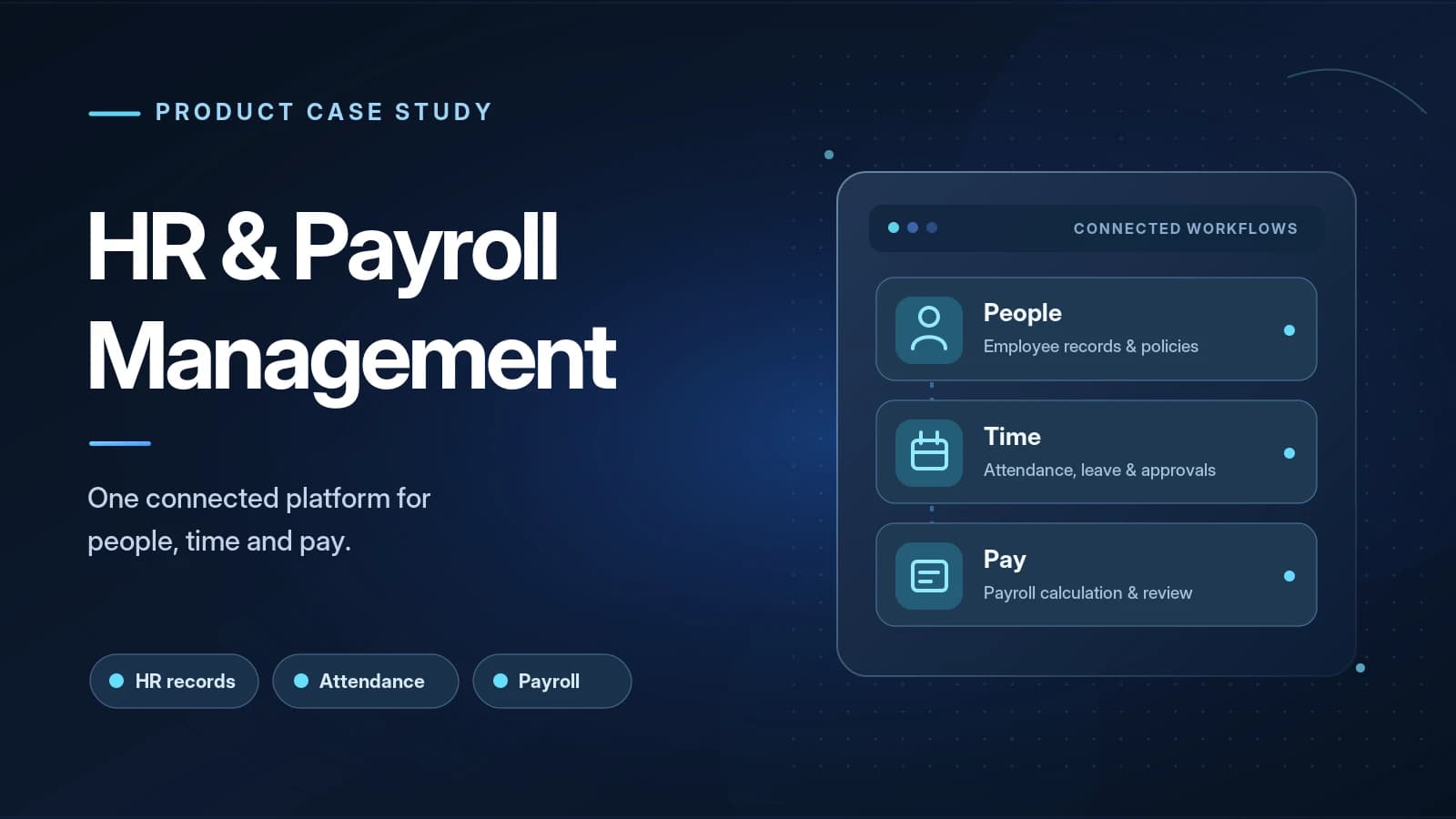
Syftnex HR & Payroll Case Study: Building a Connected, Modular Workforce Management Platform
Payroll problems rarely begin with the final salary calculation. They begin earlier, when attendance is stored in one place, leave approvals happen somewhere else, employee records become outdated, and finance has to assemble the truth from several files before salaries can be released. For a small team, that process may look manageable. As headcount, branches, employment types, and approval levels increase, the weaknesses become harder to ignore.
Syftnex approached this problem by building an HR and payroll management platform around a connected employee record. Instead of treating payroll as a standalone calculator, the product links organizational structure, attendance, leave, compensation, employee services, and reporting. Its modular design allows businesses to start with everyday HR operations and introduce additional capabilities as their requirements become more complex.
This case study examines the product challenge, design decisions, Laravel-based architecture, and operational workflows described in Syftnex's published material. It is a case study of Syftnex's own software product, not a claim about a named customer deployment. Where business benefits are discussed, they are expected advantages of the documented workflows rather than independently measured reductions in cost, errors, or processing time.
Project Overview
Syftnex HR & Payroll is designed for organizations that need to manage people, working time, and compensation without maintaining separate administrative systems. The platform describes 14 integrated modules, with a core foundation covering employee management, attendance, leave, payroll, document handling, notifications, and reporting. Additional capabilities include recruitment, onboarding, performance reviews, training, benefits, loans, and integrations, depending on the selected configuration.
The central design principle is that one employee should not have multiple competing versions of their employment record. A person's department, reporting manager, salary structure, working schedule, leave status, and payroll information need to remain connected. That relationship makes it possible to route approvals correctly, explain a calculation, and produce reports based on consistent inputs.
- Product: Syftnex HR & Payroll Management System.
- Business area: human resource management, workforce administration, and payroll processing.
- Core objective: connect the employee lifecycle to accurate, reviewable payroll workflows.
- Architecture described by Syftnex: Laravel, modular service providers, asynchronous processing with queues and Horizon, tenant isolation, and audit logging.
- Primary users: HR administrators, payroll and finance teams, department managers, employees, and business leadership.
- Evidence boundary: published product capabilities and engineering decisions; no verified customer-level performance figures are supplied.
The Challenge: Disconnected HR Work Creates Payroll Risk
Too Many Systems for One Employee
A common HR workflow starts with a spreadsheet of employee details, an attendance device, a separate leave register, and messages exchanged between managers and HR. These tools may each serve a purpose, but they do not necessarily share the same data. When someone transfers to another department or receives a salary adjustment, one record can change while another remains untouched. The discrepancy may not surface until the payroll deadline.
The resulting work is more than data entry. Someone must check employee status, identify missing attendance, confirm approved leave, resolve overtime questions, calculate deductions, and prepare figures for finance. Each manual handoff creates an opportunity for a late correction or an unexplained difference between the payroll register and the employee's payslip.
Approval Decisions Become Difficult to Trace
Leave approved through a chat message is difficult to reconcile if the attendance report still shows an absence. A verbal overtime approval may not explain which multiplier should apply. An employee's bank details can be updated in one file without a recorded authorization. Even when every person involved acts carefully, the process lacks a reliable sequence of decisions that a new team member can follow.
For employers, that gap matters during routine financial review, employee disputes, and statutory checks. A payroll figure is only as defensible as the records and rules behind it. The challenge was therefore not simply to digitize forms. It was to connect information, permissions, calculations, and review steps into one repeatable process.
The Product Strategy: Build Around the Organization, Not Around a Generic Form
Syftnex's solution begins with the organization's structure. Legal entities, divisions, departments, teams, branches, positions, job grades, and reporting lines provide the framework for the rest of the platform. The same hierarchy determines who approves a request, where payroll costs are assigned, which policy an employee follows, and how leadership views headcount.
This is a meaningful design choice because an HR system can have sophisticated features and still produce poor information if employees are attached to the wrong department or manager. The structure is not a decorative organization chart. It becomes the context used by attendance rules, salary structures, approval routing, and workforce analytics.
Shift planning follows the same idea. Fixed schedules, rotating shifts, and flexible arrangements can be assigned to relevant employees or groups. Rather than expecting finance to interpret raw punch times at month-end, attendance can be assessed against the schedule that actually applies to each worker.
One Employee Record Across the Employment Lifecycle
From Joining Details to Daily Administration
At the center of the platform is a structured employee profile. It brings together contact information, emergency contacts, employment identifiers, bank details, department, designation, branch, manager, employment type, and compensation-related fields. Syftnex also describes configurable employee IDs and custom fields for organizations with their own record requirements.
The value of this model lies in relationships rather than the number of fields. When an employee changes departments, the updated reporting line can inform future approvals. When a job grade changes, it can affect the pay structure or benefits assigned to that grade. Because the platform links these areas, HR does not need to treat every change as a separate spreadsheet maintenance task.
Making Employee Changes Traceable
Employment status is not static. People join, go on leave, change roles, resign, or leave after termination. Syftnex describes timestamped status transitions and a structured offboarding process that coordinates responsibilities across HR, finance, and IT. For example, an exit checklist can bring together equipment return, outstanding advances, document collection, and the final settlement process.
Final settlement is particularly sensitive because it may include salary for part of a month, leave encashment, advances, notice-period adjustments, or other amounts determined by policy and applicable law. Connecting those inputs to the employee's history creates a clearer basis for review. The final calculation still requires the organization's approved rules and sign-off; software should support accountability rather than replace it.
Attendance Management Designed for Real Working Conditions
Attendance is often the first major point of friction between HR and payroll. Data may originate from office biometric devices, web check-ins, or mobile attendance for field teams. Each source has different operational constraints, but payroll ultimately needs a coherent account of working time.
Syftnex describes attendance capture through the web portal, mobile GPS, biometric CSV imports, and device APIs. The system records punch-in and punch-out information, working hours, and overtime, while shift-level grace periods help distinguish approved scheduling rules from exceptions. This reduces dependence on an individual manually converting raw attendance exports into salary inputs.
Overtime Requires an Approval, Not Just a Formula
Overtime is a good example of why connected workflow design matters. The system can detect hours beyond a configured shift, flag them for approval, and apply the appropriate multiplier after approval. That separation helps prevent every extra punch minute from automatically becoming a payroll liability. Different job grades may follow different overtime arrangements, so the calculation has to be configurable rather than universally hard-coded.
Attendance dashboards also give managers a timely view of lateness, absences, and work patterns. The purpose is not to turn every attendance exception into a penalty. It is to make the underlying record visible early enough for the employee, manager, and HR team to resolve it before payroll is locked.
Leave Management Connected to Attendance and Salary
Leave policies are rarely identical across organizations. Annual leave, sick leave, parental leave, unpaid leave, carry-forward rules, and encashment eligibility may vary by employment category, contract, and local requirements. A system that assumes one universal policy can create as much administrative work as it removes.
Syftnex's leave module allows policy configuration, accrual methods, balance checks, approval routing, and year-end processing. Requests can be checked for available balances and potential conflicts before reaching the responsible manager. Once approved, the decision becomes available to attendance and payroll instead of remaining in an email thread.
Consider an employee taking approved unpaid leave during a pay period. In a disconnected process, HR may approve the request but finance may not receive it before salary computation. In the connected model, the leave status becomes a defined input to payroll. That is the practical advantage of integration: a legitimate HR decision can travel to the place where its financial effect must be handled.
The Payroll Engine: Turning Verified Inputs into Reviewable Pay Runs
Different Employment Types, One Controlled Process
Payroll becomes complicated when an organization employs monthly salaried staff, daily-rated workers, and hourly contractors at the same time. Salary structures can include base pay, housing or travel allowances, bonuses, overtime, loan repayments, advances, and statutory deductions. Each component may be calculated as a fixed amount, a percentage, or a more specialized formula.
Syftnex describes a configurable payroll engine that supports these variations within a common processing workflow. Compensation rules are associated with salary structures rather than recreated independently for every employee. The product also describes calculations that work backward from a total compensation figure when a hiring arrangement is expressed as an overall package.
The significance is consistency. A change to an approved salary rule should be made in the appropriate configuration and applied to the relevant employees, instead of relying on someone to update dozens of spreadsheet cells correctly. At the same time, unusual cases must remain visible rather than disappearing inside automated totals.
The Four Stages of a Payroll Run
The public product description presents payroll as a controlled sequence rather than a single calculate button. Inputs are prepared and locked for the period, salaries are computed, exceptions are reviewed, and approved output is prepared for disbursement. This separation gives finance a deliberate checkpoint before information is sent to a bank or shared with employees.
- Initiate and lock: confirm the pay period and freeze the attendance and leave inputs used for that run.
- Compute: calculate earnings, approved overtime, allowances, recoveries, and configured deductions.
- Review exceptions: investigate incomplete records, mid-period joiners or leavers, unexpected overtime, and other anomalies.
- Approve and prepare output: generate employee payslips and appropriately formatted bank disbursement files after the required reviews.
A generated bank file is not the same as a completed payment. Actual bank acceptance, funds movement, and reconciliation depend on the organization's payment process and banking arrangements. Distinguishing preparation from successful disbursement keeps the case study aligned with what the described product workflow establishes.
Handling Payroll at Scale with Background Processing
The technical challenge grows as the number of employees increases. Processing each person's salary may involve attendance, approved overtime, leave, loan balances, statutory rules, and customized earnings components. Running every computation inside one long browser request can create timeouts and make recovery difficult if an individual record fails.
Syftnex's engineering account describes the use of Laravel queues and Horizon to process payroll work asynchronously, with employee-level jobs and a way to review failures. This design allows the payroll officer to see progress and investigate exceptions without assuming that one unusual record should interrupt an entire pay run. The value is operational resilience: problems can be isolated and addressed before final approval.
Compliance Built into Calculation, with Jurisdiction Checks Before Rollout
Payroll compliance is not limited to exporting a monthly report. The applicable tax, social insurance, contribution, and employment rules influence the numbers generated for every pay period. A system therefore needs both configurable rules and a record of which rules were in effect when a calculation was made.
Syftnex's engineering article describes date-effective statutory configuration so a historical payroll period can be interpreted against its applicable rates instead of current defaults. The broader product material discusses statutory deductions and annual reporting, while its Pakistan-focused content refers to income tax withholding, EOBI, and provincial social security considerations such as PESSI and SESSI.
These descriptions should not be interpreted as a blanket guarantee of compliance in every country, province, or industry. Before implementation, a buyer should verify the relevant jurisdiction, required contribution ceilings, taxable pay definitions, official report formats, and any bank or filing integrations. A parallel payroll run using a redacted historical period is an especially practical way for HR and finance to identify differences before switching processes.
The central lesson is that compliance needs to be part of the calculation model and its review procedure. It cannot safely be delegated to a year-end spreadsheet that attempts to reconstruct twelve months of decisions after payments have already been made.
Employee and Manager Self-Service Without Losing Control
Not every HR task should require an administrator to find a file and reply to an employee. Payslip access, leave balance checks, attendance queries, and document retrieval are routine requests that can be easier to manage through a self-service portal. Syftnex describes employee access to these records, along with channels for requesting leave and attendance corrections.
Self-service does not mean unrestricted editing. The product specifies approval workflows for changes to sensitive information, including bank details. Managers also receive a separate view of department attendance, pending approvals, and headcount rather than unrestricted access to the whole HR database.
This separation addresses two problems at once. Employees gain a clearer route to their own information, while HR retains oversight of changes that could affect pay, identity, or records of employment. It also reduces the need for managers to obtain full administrative privileges simply to approve a leave request.
Extending the Platform Beyond Monthly Payroll
Recruitment, Onboarding, and Performance
The broader product scope extends into recruitment and talent development. Hiring requisitions can move through approval stages, candidates can progress through structured assessments, and offer documentation can connect to onboarding steps. The purpose of this connection is continuity: a successful candidate should become an employee record through a defined process rather than disappear between the recruitment system and HR administration.
Performance management is described through KPI, OKR, and 360-degree review approaches, with configurable rating scales and mid-cycle check-ins. Where an organization chooses to link performance to compensation, the platform can provide a recorded basis for merit decisions. This is more useful than treating a review score as an isolated document, although the fairness of the process still depends on sound policy and human judgment.
Training, Benefits, Loans, and Documents
Syftnex also describes a training catalog with enrollment, assessments, completion records, and reporting. Benefits can be assigned by criteria such as grade or department, while expense reimbursements, salary advances, and loan repayment schedules connect to compensation administration. These functions reflect a broader goal: recurring employee-related transactions should have a recorded request, decision, and financial consequence where applicable.
Document management supports employment contracts, identification records, policies, version history, and expiry reminders. For HR teams, a missing document or an outdated policy acknowledgment can become an issue long before a payroll error appears. Keeping document checks beside the employee lifecycle gives the organization a more complete operating record.
These advanced areas are modular rather than necessarily included in every subscription. Organizations should confirm their chosen modules, pricing, implementation scope, and dependencies before assuming that every capability is active from day one.
Multi-Branch Operations and Reporting for Leadership
A multi-branch organization faces a particular information challenge. Each location may have its own supervisor, attendance device, and staffing pattern, but head office still needs a coherent picture of payroll spending and workforce availability. If each branch applies its own spreadsheet formulas, comparison becomes unreliable even when the figures appear to use the same labels.
Syftnex describes central policy configuration, branch-level permissions, consolidated attendance visibility, employee transfers that preserve history, and payroll processing across branches. Its multi-branch material also discusses biometric device connections for separate locations. These capabilities are relevant to school networks, retail operations, healthcare groups, manufacturing businesses, and organizations managing teams across different cities.
The reporting module brings together headcount, attendance, payroll registers, attrition trends, and other workforce indicators. Custom reports, scheduled exports, and dashboards can reduce the dependence on ad hoc spreadsheet requests. For leadership, the important result is not simply more charts. It is the ability to follow a figure back to consistent underlying records and ask a focused question when something looks unusual.
Architecture and Security: The Decisions Behind the Workflows
Modular Laravel Services
A key architectural choice described in Syftnex's technical writing is to organize features as modular Laravel service providers. Modules register their own routes, permissions, and dependencies when enabled. This approach can keep a smaller customer configuration focused while allowing broader capability to be introduced later without redesigning the entire employee record model.
Modularity also changes how the product can be tested and maintained. Teams can assess the boundaries of attendance, leave, payroll, and recruitment individually, then test how data passes between them. A disabled feature should not create unnecessary user-facing complexity. That is particularly relevant to organizations whose immediate priority is accurate payroll rather than adopting every HR function at once.
Tenant Isolation and Permission Boundaries
Payroll applications hold sensitive records, including salary details, tax identifiers, and bank information. Syftnex's engineering retrospective reports that the team moved from a shared-database tenancy model toward separate databases for tenants after identifying a risk involving incorrectly scoped data access. The current product overview describes tenant-scoped access and recommends testing administrative views, exports, APIs, and background jobs as part of technical evaluation.
That distinction matters. Architectural descriptions explain an intended approach; a security review must still verify the deployed configuration, permission boundaries, and data-handling behavior. Within an organization, the product describes record-level permissions, typed roles, and field restrictions so a department manager can manage relevant staff without automatically seeing sensitive payroll data for everyone.
Audit Trails and Integration Interfaces
Syftnex's engineering article also describes an append-only audit approach with linked hashes to make unauthorized record changes detectable. The product overview emphasizes logging of sensitive access and actions. For payroll, an audit history is useful because a dispute often concerns not only the final amount but who changed a rule, when an approval occurred, and which inputs were available at the time.
Versioned REST APIs and webhooks are part of the integration story. Accounting software may need approved payroll totals, biometric systems may supply attendance events, and other business applications may need selected employee or organizational information. Each integration should have a clear scope, authentication controls, failure handling, and acceptance tests. Connectivity is valuable only when data ownership and error recovery are understood.
Implementation Approach: Reduce Risk Before Replacing a Working Process
A move from spreadsheets to an HR platform should be treated as a controlled operational change, not simply a software installation. Existing employee data may contain duplicate IDs, inconsistent department names, missing bank details, or salary components whose meaning is known only to one experienced payroll officer. Importing that data without review transfers the underlying uncertainty into a new system.
The product's own implementation guidance recommends comparing a redacted historical pay period with existing approved registers and payslips. That is the right starting point for payroll migration because it allows the business to test real policies without exposing unnecessary personal information or risking an active disbursement cycle.
- Map organizational entities, branches, reporting lines, employment types, shifts, and approval responsibilities.
- Clean employee master data and confirm which system will own each field after migration.
- Configure leave balances, overtime rules, pay components, deductions, and jurisdiction-specific statutory settings.
- Test attendance imports, manager approvals, correction requests, and exceptional employment changes.
- Run a parallel payroll period, explain differences employee by employee, and document rounding and adjustment rules.
- Obtain HR and finance approval before moving from comparison to live payroll processing.
- Train employees and managers on self-service, access permissions, and support procedures.
For an organization with existing branches, the scope may also include device compatibility checks, historical data import, and branch-level access testing. Timelines should be agreed against the actual data and integration work, not inferred from a standard package description. Most importantly, the old process should remain available until the finance owner accepts the reconciled figures.
What the Product Establishes and What Still Needs Measurement
The publicly described outcome is a live HR and payroll product with a connected data model, modular feature structure, payroll computation workflow, self-service capabilities, reporting, and architectural decisions aimed at reliability and auditability. Syftnex's engineering write-up provides more detail about why the team chose asynchronous processing, modular loading, rate versioning, and stronger tenant separation.
Those are meaningful product and engineering outcomes. They are not the same as evidence that a particular customer reduced payroll processing time by a certain percentage or eliminated all errors. No independently verified deployment metrics, before-and-after financial results, or named customer payroll records were provided in the reviewed material. A responsible case study keeps that boundary clear.
Practical Measures for a Customer Deployment
If an organization adopts the platform, the strongest future success measures would come from its own operations. A baseline should be collected before rollout, and the same indicators should be checked after enough payroll cycles to account for exceptions, leave patterns, and staff changes.
- Time spent preparing, checking, approving, and reconciling each payroll cycle.
- Number of payroll exceptions identified before approval versus corrections required after payment.
- Percentage of attendance and leave inputs verified before the payroll lock date.
- Average time for a manager to approve leave or overtime requests.
- Number of unresolved employee pay queries and the time taken to investigate them.
- Ability to reproduce historical payroll outputs using documented rules and source records.
- Completeness of audit logs, document checks, and access-control testing.
These measures would show whether the connected workflow is producing the intended operational value. They would also expose problems caused by configuration, poor source data, or insufficient staff training that software features alone cannot solve.
Lessons from Building a Reliable HR and Payroll Product
The strongest lesson from this project is that accurate payroll is a system-wide responsibility. A better calculation engine cannot compensate for incorrect attendance inputs, outdated employee records, or undocumented approval decisions. Connecting those parts makes exceptions easier to investigate and reduces the number of separate records teams must reconcile.
A second lesson concerns architecture. Modular services help match the platform to different business sizes, while asynchronous processing gives variable payroll workloads a more resilient execution model. Historical rate configuration and audit records help teams explain decisions long after a pay period has closed. These are not features that most employees will notice directly, but they matter when finance needs to trust a result.
The third lesson is that security and operational fit require verification. Permissions should be designed around actual roles, integrations should be tested end to end, and statutory calculations should be reviewed against the employer's jurisdiction. Syftnex's own retrospective notes the cost of introducing field-level permissions and API versioning too late. That experience reinforces the importance of establishing access rules and interface boundaries early.
Finally, implementation success depends on people. HR, finance, IT, managers, and employees each interact with different parts of the system. The transition works best when the organization agrees on who owns data quality, who approves exceptions, and which evidence is required before payroll is released.
Who Can Benefit from This Approach?
The platform's design is particularly relevant to growing businesses that have moved beyond an informal HR process. A company may begin with employee records, attendance, leave, and payroll, then add modules when recruitment volume, performance reviews, training administration, or benefits management justify the additional scope.
Organizations with multiple branches can use consistent policies and reporting while preserving local management responsibilities. Businesses with mixed salary structures can benefit from configurable earnings and deduction logic. Companies operating in regulated environments may value reproducible payroll history and better-defined access to sensitive records, provided the relevant compliance requirements are verified during implementation.
There is no single implementation pattern that fits every employer. A smaller organization may care most about reducing handoffs and making payslips accessible. A larger employer may prioritize approvals, integration testing, exception review, and departmental cost reporting. The modular approach is intended to accommodate those differences without losing the common employee record at the center.
Frequently Asked Questions
What makes Syftnex HR & Payroll different from a basic payroll calculator?
The product connects payroll to employee data, attendance, leave, salary structures, and approval workflows. A basic calculator may produce a net salary figure, but it does not necessarily explain how changes in working time, leave status, benefits, or employee lifecycle events affect that amount.
Can a business begin with core HR and add other modules later?
Yes. Syftnex describes a modular configuration with core HR and payroll functionality and optional modules for areas such as recruitment, performance, training, benefits, and integrations. Buyers should check which features are included in their selected plan and which require separate activation or pricing.
Does the system support biometric attendance and multi-branch teams?
The published material describes biometric imports and API-based device connections, as well as branch-level structures, permissions, and consolidated reporting. Real device models, import formats, network requirements, and integration responsibilities should be tested during scoping rather than assumed compatible.
Does automated payroll remove the need for finance approval?
No. The described payroll lifecycle includes exception review and approval before output is prepared for disbursement. Automation organizes calculations and input handling, while responsible employees remain accountable for checking unusual cases, reconciling results, and authorizing release.
Is statutory compliance guaranteed for every location?
No software description should be treated as universal legal or tax certification. Syftnex provides configurable statutory capabilities and discusses country-specific requirements, but an employer must validate current rules, output formats, filing duties, and payroll calculations for the places where it operates.
Conclusion: A More Accountable Way to Run HR and Payroll
Syftnex HR & Payroll illustrates a product approach that treats payroll as the final step in a connected employment workflow rather than an isolated monthly exercise. Organizational structure shapes permissions and reporting. Employee records inform attendance and leave. Approved changes feed compensation calculations. Review checkpoints, access controls, and audit history help teams explain how a result was reached.
The platform's modular Laravel architecture provides room to expand beyond the essentials, while queued computation and integration interfaces address the technical demands of larger operations. The public material supports a detailed account of these capabilities and the thinking behind them, though a customer-specific return on investment would need to be demonstrated through real deployment data.
For an organization considering the move away from fragmented HR tools, the next step is a practical assessment: map the current process, prepare an approved sample payroll period, test the integrations and permissions that matter, and compare calculated outputs with finance's existing records. Syftnex offers product demonstrations and implementation discussions for teams that want to evaluate that fit before committing to a migration.